Aggressive Fat Loss
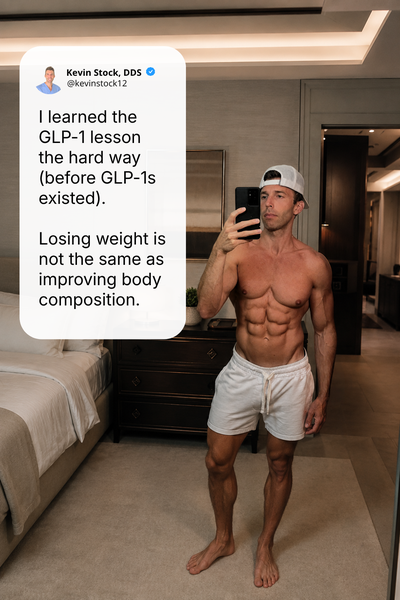
The problem with a steep calorie deficit is that you don’t just lose fat, but you are much more prone to lose muscle too.
So after cutting my calories by 50%, I’d rapidly
lose weight (while starving), until I hit a plateau that was impossible to break through because I was already starving, only to find that I was smaller and lighter, but with less fat AND less muscle. I’d be flatter and weaker. Skinny fat.
Then, when I inevitably started eating more again, the fat tended to come back much faster than the muscle did. So now I was in a worse position than when
I started: More fat. Less muscle. And a lower metabolic rate which would make the next diet even harder.
It took me a long time to understand this: Losing weight and improving body composition are not the same thing.
And that is one of my biggest concerns with GLP-1s.
These drugs make it incredibly easy to eat less. Weight drops fast. And it becomes easy to convince yourself that everything is working because the number on the scale keeps dropping.
Meanwhile, you become a smaller, weaker, slower metabolic version of yourself.
And then, say you want to stop...
Maybe the cost rises.
Maybe you’re tired of the nausea, constipation, or other GI issues.
Maybe you’re concerned about pancreatitis, gallstones, dehydration and electrolyte problems, or the FDA’s thyroid C-cell tumor warning.
Maybe, like me, you still have questions about long-term cancer risk or what years of suppressing appetite and reward signaling might do to motivation, libido, and drive. God knows we don’t need more listless people.
What happens?
Hunger comes back. The weight comes back fast. Or I should say, the fat comes back fast. But the muscle you lost doesn’t magically return with it.
That’s
how you can lose 40 pounds, regain it, and end up with worse body composition and metabolic health than where you started.
For some people, the benefits of GLP-1s may be worth the risks.
My concern is how many of the 1 in 8 people taking them are using the drug as a replacement for the
lifestyle that actually creates a strong, healthy body they can maintain long-term.
Hypothetically, if I had to use a GLP-1, this is how I’d view/do it:
I would use it only as a temporary tool to help lock in the lifestyle.
I would start with a microdose. I would only consider
small increases after legitimate stalls to create a slow, progressive caloric deficit.
I would aim for roughly 1 gram of high-quality animal protein per pound of target body weight, spread across 3 meals.
I would put a huge emphasis on resistance training and progressive overload.
I’d measure body fat percentage, not just the scale.
Once I reached my goal, I’d be crystal clear that this is when the goal shifts from maximizing fat loss while minimizing muscle loss…to minimizing fat regain while maximizing muscle gain.
I’d do this by gradually tapering off the drug, which would slowly bring my food intake back up (essentially a
reverse-diet approach).
I’d keep protein high, stick to a meat-based whole-food diet, and keep PUFA intake very very low.
I’d focus on progressive overload in the gym basically having the same mindset I’d bring to a “lean bulk” in bodybuilding.
I’d continue this until I was completely off the GLP-1 and beyond.
From there, I’d continue to use the meat-based whole-food diet to control my appetite and body composition. Not a drug.
TL;DR
Lifestyle first: meat-based whole food diet, sleep, sunlight, and resistance training.
GLP-1: Microdose as a
temporary bridge to results and adopting a healthy lifestyle. Tapering on then off to minimize muscle loss and fat regain.